The strongest hand exerciser on this list takes 100 lbs. of squeeze to close. The gentlest is a piece of medium foam you can press with stiff, tired fingers.
That gap is the whole buying problem, as each type also trains a different movement. A gripper builds crushing grip but won’t train your hand to open or your wrist to twist.
Below are 5 hand exercisers, one per main type, ranked from most versatile to specialized. Each says who it suits and who should skip it, so it fits your fingers and goals.
Picking the Right Hand Exerciser
The Rolyan Ergonomic Hand Exerciser is best for most, as its 4 graded bands cover rehab and everyday strength. Lifters need a 100 lb. gripper, and squeezers an extension trainer.
Most people need one squeeze tool plus one opening tool.
We picked these 5 pieces of exercise equipment on four things, without running our own lab tests:
- Movement trained: closing, opening or twisting the hand.
- Resistance and progression: how easily you can start light and move up.
- Comfort and fit: padded or knurled handles, latex-free materials.
- Verified listing: each pick is a real product on Amazon, checked by ASIN.
So start with the line under each pick that says who it suits. It tells you in one sentence whether that pick fits your fingers, wrists and goals.
Here’s how the 5 exercisers compare at a glance:
| # | Product | Our Rating | ||
|---|---|---|---|---|
| 1 |  |
Rolyan Ergonomic Hand Exerciser with Padded Handle | ★★★★☆ | Check Price |
| 2 | 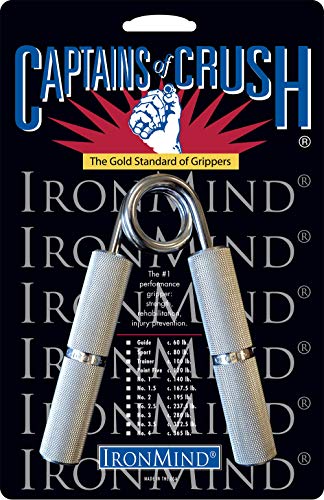 |
Captains of Crush Hand Gripper Trainer (100 lb.) | ★★★★☆ | Check Price |
| 3 |  |
DSS Xtensor Finger Extension Exerciser | ★★★★☆ | Check Price |
| 4 |  |
Northcoast Medical Slo-Foam Hand Exerciser (Medium, 3-Pack) | ★★★★☆ | Check Price |
| 5 |  |
DSS CanDo Twist-n-Bend Flexible Exercise Bar (12 Inch, Red) | ★★★★☆ | Check Price |
1. Rolyan Ergonomic Hand Exerciser with Padded Handle
Rolyan Ergonomic Hand Exerciser with Padded Handle
An adjustable squeeze tool with a padded handle and 4 pairs of color-coded, non-latex bands for hand rehab and steady grip work.
Pros
- 4 pairs of color-coded bands (yellow, red, green, blue) for graded resistance
- Bands swap easily as your grip gets stronger
- Padded handle is contoured to sit in the palm
- Adjustable frame supports blocking and extension work
- Non-latex bands suit people with latex sensitivity
Cons
- Listing gives no pound rating for the bands, so you progress by color
- Swapping band pairs takes a minute between sets
The Rolyan Ergonomic Hand Exerciser is the best hand exerciser for most people because it covers light rehab and steady strength work.
It does that with 4 pairs of color-coded bands (yellow, red, green and blue) that you swap as your grip improves.
It suits anyone rebuilding a weak grip after surgery or injury, or starting hand exercise from zero. Skip it if you already close heavy steel grippers.
Here’s how the band system works in practice.
- Start on the yellow pair and do a set of slow squeezes. If the last few reps feel controlled, you’re on the right band.
- Stay on that color until the set feels easy, then move up to red. Green and blue follow the same way.
- Use the adjustable frame for blocking and extension work if a therapist gives you those exercises. That frame is what separates it from a plain spring gripper.
The padded, contoured handle sits in the palm, so the pressure spreads across your hand instead of digging into one spot.
And because the bands are non-latex, the Rolyan works for people who react to latex.
What about the closest alternative here?
Compared with the Captains of Crush gripper (#2), the Rolyan gives up raw resistance for range. The gripper is a single fixed level, while the Rolyan steps through 4.
Key Takeaway: If you can only buy one hand exerciser and you’re not sure where your hand stands, buy this one.
2. Captains of Crush Hand Gripper Trainer (100 lb.)
Captains of Crush Hand Gripper Trainer (100 lb.)
A 100 lb. torsion-spring gripper with knurled billet aluminum handles, made in the USA by IronMind, and part of a line offered in 11 strengths.
Pros
- 100 lb. rating gives a clear, repeatable strength target
- Knurled aircraft-grade aluminum handles hold a sweaty grip
- Line comes in 11 strengths, so the next step up is always there
- Made in the USA by IronMind, which has built grip gear since 1988
- Fits in a gym bag or desk drawer
Cons
- Fixed resistance means buying a new gripper to progress
- Too heavy for rehab or arthritic hands
The Captains of Crush Trainer is a 100 lb. torsion-spring gripper, and it’s the pick for building crushing grip strength.
IronMind makes it in the USA, and the line comes in 11 strengths, from beginner models up to levels marketed for “World’s Strongest Man” contenders.
It’s made for lifters, climbers, martial artists and anyone with healthy hands who wants a measurable strength goal. Skip it if you’re in rehab or have painful joints.
Why does a fixed level matter?
Because a full close at 100 lbs. either happens or it doesn’t. That makes your progress easy to read, with no dial to second-guess.
The handles are knurled aircraft-grade billet aluminum. Knurling is the crosshatch texture on a barbell, and here it keeps the gripper from sliding when your palms sweat.
Here’s the catch: a fixed spring can’t get lighter. If you can’t close the Trainer on day one, you’ll need a lighter model from the same line, not more effort.
A simple way to check your level:
- Set the gripper deep in your palm with your wrist straight.
- Squeeze until the handles touch, then open slowly.
- If you can’t get a single clean close, step down; if sets feel easy, step up a model.
Compared with the Rolyan (#1), this is the stronger trainer and the worse rehab pick. In other words, pick by where your hand is today, not where you want it to be.
3. DSS Xtensor Finger Extension Exerciser
DSS Xtensor Finger Extension Exerciser
A finger extension trainer that resists the hand as it opens, working the muscles that squeeze-only tools leave out.
Pros
- Works the finger extensors that grippers and balls skip
- Pairs with any squeeze tool for balanced training
- Simple to use: fingers in, then open the hand
- No springs to set or bands to swap
Cons
- Does nothing for crushing grip on its own
- Amazon listing gives few specifications
The DSS Xtensor is a finger extension exerciser: it resists your hand as it opens instead of as it closes.
That trains the finger extensors, the muscles on the back of the forearm that most grip tools never load.
It suits anyone already using a gripper, squeeze ball or foam, plus musicians and climbers who want balanced hands and better finger dexterity.
Skip it if you want one tool that builds crushing grip by itself.
So why train opening at all?
Every squeeze tool on this list works the muscles that close your fingers.
Pairing that with opening work keeps both sides of the hand in step instead of loading one side over and over.
Using the Xtensor takes seconds. Slip your fingers into the Xtensor, then spread and straighten them against the resistance, and return slowly.
A good pattern is to alternate. Do a set on your squeeze tool, then a set on the Xtensor, so the flexors and extensors share the work in one short session.
Compared with the Rolyan (#1), which supports some extension work through its frame, the Xtensor is built only for opening. That focus is the point.
Pro Tip: Keep the Xtensor next to whatever you squeeze. If it lives in a drawer, the opening half of your routine won’t happen.
4. Northcoast Medical Slo-Foam Hand Exerciser (Medium, 3-Pack)
Northcoast Medical Slo-Foam Hand Exerciser (Medium, 3-Pack)
A 3-pack of medium foam hand exercisers from Northcoast Medical (NC59553) for light squeezing and finger flexing.
Pros
- Foam gives gentle resistance with no spring to fight
- Low resistance suits stiff fingers and early rehab
- 3 pieces let you keep one at home, at work and in the car
- Nothing to adjust or set up
Cons
- Only one density (medium) in this pack
- Listing warns the photo may differ from the product
The Northcoast Medical Slo-Foam Hand Exerciser is a medium foam piece you squeeze and release for light hand work. This 3-pack (model NC59553) is the gentlest option on the list.
It’s the one for stiff fingers, early rehab and anyone who finds springs and bands too much. Skip it if you want measurable strength gains.
Foam is one of the main materials hand exercisers are made from, along with rubber and plastic.
The difference is how it pushes back: foam gives way evenly, with no spring trying to snap your fingers open.
Here’s what a session can look like:
- Squeeze the foam with your whole hand, hold briefly and release slowly.
- Press it between your thumb and each fingertip in turn.
- Roll it under your palm on a table to warm up before other work.
The 3 pieces are a practical touch. Keep one by the couch, one at your desk and one in the car, and you’ll actually use them.
Note: The Amazon listing warns the photo may differ from the product, so check the model number NC59553 and the medium density on the box when it arrives.
Compared with the Rolyan (#1), Slo-Foam has one resistance level and no way to progress inside the pack. It’s a starting point, not a whole program.
5. DSS CanDo Twist-n-Bend Flexible Exercise Bar (12 Inch, Red)
DSS CanDo Twist-n-Bend Flexible Exercise Bar (12 Inch, Red)
A 12-inch flexible CanDo bar you twist, bend and wring with both hands to work the wrists, forearms and grip together.
Pros
- Trains twisting and bending moves that squeeze tools miss
- Works both hands, wrists and forearms at once
- One-piece bar with nothing to adjust
- Usable seated, with elbows resting on a table
Cons
- A 12-inch bar is less portable than a gripper or foam piece
- One resistance per bar, so progressing means a firmer bar
The DSS CanDo Twist-n-Bend is a 12-inch flexible bar you twist, bend and wring with both hands.
It trains your wrists, forearms and grip together, in movements a squeeze tool can’t copy.
It’s built for people whose weak point is the wrist or forearm, such as twisting lids or turning tools. Skip it if your goal is finger strength or a stronger crush grip.
Think about how often you twist something in a day. Jar lids, door handles and screwdrivers all ask your wrists to rotate under load, which is exactly what this bar trains.
Three moves cover most of what it does:
- Hold the bar at both ends and twist your hands in opposite directions, like wringing a towel.
- Bend the bar into a U shape, then straighten it slowly.
- Hold it upright and rock it side to side to work the wrists.
If twisting lids is what bothers you most, the bar pairs well with an easier jar opener while your strength builds. One trains the hand; the other takes the strain off today.
Compared with the Xtensor (#3), the Twist-n-Bend works a different gap: wrist rotation instead of finger opening. Both are add-ons to a squeeze tool, not replacements for one.
Hand Exerciser Types and What Each One Trains
Hand exercisers come in 6 main types: spring grippers, band squeeze tools, foam or therapy balls, finger extension trainers, flexible bars and individual finger exercisers.
Each one trains a different movement, which is why the picks above cover 5 of them.
According to the hand exerciser FAQ at DICK’S Sporting Goods, a retailer, hand exercisers are often made from rubber, plastic and foam.
The material tells you a lot about the feel: steel springs push back hardest, while foam gives the softest resistance.
- Spring grippers (#2) build crushing grip in the fingers and forearm flexors.
- Band squeeze tools (#1) cover rehab and general strength with swappable resistance.
- Foam and therapy balls (#4) suit gentle work, warm-ups and stiff joints.
- Extension trainers (#3) work the muscles that open the hand.
- Flexible bars (#5) train twisting and bending at the wrist.
The sixth type is the individual finger exerciser, such as the Prohands Gripmaster, with one spring button per finger for finger isolation and dexterity.
None made this list because none of the guides we measured recommended one.
So pick by movement first and brand second. A gripper and a foam ball are both “hand exercisers”, but they solve different problems.
Do Hand Exercisers Actually Work?
Yes, hand exercisers work for the movement you train with them: a gripper builds crushing grip, an extension trainer builds hand opening, and soft foam keeps stiff fingers moving.
Hand exercisers are also common in rehabilitation, where they help rebuild strength and improve mobility after injuries.
The catch is that they don’t transfer to everything. A stronger close on a gripper won’t, by itself, train your wrist rotation or your ability to open your hand.
That’s why progression matters more than the model. If you squeeze the same easy level for months, your hand has no reason to adapt.
Key Takeaway: Hand exercisers work when you match the exerciser to the movement you want, and move up in resistance as it gets easy.
How to Choose the Right Resistance
Beginners should choose a hand exerciser they can use for clean, controlled reps on day one, and the easiest way to do that is adjustable or graded resistance.
Models with adjustable resistance suit both beginners and advanced users.
Here’s how that plays out with the picks above:
- Graded bands (#1): start on yellow, move to red, green and blue.
- Fixed grippers (#2): the Captains of Crush line runs through 11 strengths, so you buy the level you can close.
- Foam (#4): one medium level, best as a starting point.
Adjustable spring grippers go further on paper.
The AIXPI Grip Strength Trainer, for example, is listed on Amazon as adjustable from 11 to 132 lbs., which saves buying several models.
What’s the trade-off?
A dial-adjustable gripper is flexible, but a fixed gripper gives you one honest number.
If you like clear goals, go fixed and buy the next level when you’re ready; if you want one purchase, go adjustable.
How Often to Use a Hand Exerciser
Use a hand exerciser several times a week, with rest days in between, rather than squeezing hard every day.
That’s the guidance in the DICK’S Sporting Goods FAQ, which says to listen to your body and allow for rest days to prevent overuse injuries.
Hard sessions on a gripper or firm bands need recovery, just like any other strength work.
Gentle foam work and finger stretches are easier on the tissues, so you can do those more often if they feel comfortable.
Here’s a simple weekly shape you can adapt:
- A few days a week, do your harder squeeze work (#1 or #2) followed by extension work (#3).
- On other days, keep it light with foam (#4) or a few minutes on the bar (#5).
- Take at least one full day off from hard gripping each week, and more if your fingers feel sore.
If you’re under a therapist’s care, their schedule wins over any general plan.
Using a Hand Exerciser With Arthritis, Carpal Tunnel or After a Stroke
A hand exerciser can be part of a routine for arthritis, carpal tunnel syndrome or stroke recovery, but use a gentle tool and a plan from your doctor or hand therapist.
Start with the lightest tool, not a heavy spring.
For Arthritis
For arthritis, start with the softest exerciser you have, such as the Slo-Foam (#4) or the lightest band on the Rolyan (#1), and stop if a movement causes pain.
Our research found no source that ranks one product as best for arthritis, so comfort is your guide.
Foam and light bands let you keep fingers moving without forcing a full squeeze against a spring.
If gripping itself hurts, compression gloves for arthritis are worn support, not exercise, and they can sit alongside a light routine.
For Carpal Tunnel Syndrome
For carpal tunnel syndrome, check with your doctor before using any hand strengthener, because the evidence we gathered doesn’t show that grip training treats it.
If you get the go-ahead, use the lightest resistance and stop if numbness or tingling gets worse.
Daily setup matters too. A mouse built for carpal tunnel and a padded wrist rest cut the repeated strain that a hand exerciser can’t undo.
After a Stroke
After a stroke, the right hand exerciser depends on how much the hand can already move, so an occupational or physical therapist should choose it.
A hand that can open and close a little may start with soft foam (#4) or graded bands (#1).
A hand that can’t yet open on its own needs a therapist’s plan first. Repetitive squeezing on a stiff, curled hand isn’t the place to begin without guidance.
The Disadvantages of Hand Grippers
The main disadvantages of hand grippers are overuse strain, a one-sided workout that only trains closing, and fixed springs too heavy for weak or sore hands.
Each one has a simple fix.
- Overuse strain: squeezing hard every day with no rest is a common way grip training goes wrong, so keep your rest days. Repetitive strain is one of the classic ergonomic injuries, and your hands are no exception.
- Muscle imbalance: a gripper works the flexors that close your fingers. Add an extension trainer (#3) so the opposite side keeps up.
- Wrong resistance: a 100 lb. gripper you can’t close teaches you nothing. Start with something you can move with control and without pain, then step up later.
- Narrow carryover: a stronger close won’t fix weak wrist rotation or a sore elbow. If your elbow is the problem, a mouse for tennis elbow addresses the daily cause better than more squeezing.
In other words, a gripper is one good trainer, not a whole hand program. Pair it, rest it and size it right.
Where Hand Exercisers Fit in Everyday Life
Hand exercisers are part of a bigger picture: strengthening your hands helps, but so does reducing how hard your tools make them work.
That’s the idea behind the site’s health and mobility aids section.
For example, gardeners with tired hands can pair a light grip routine with ergonomic garden tools that need less force.
Crafters can do the same with spring-loaded ergonomic scissors, which open themselves after each cut.
So train the hand, then make the job easier on it. That way, your hands get stronger while the daily load on them drops.
A hand exerciser is a small piece of exercise equipment, but it works best as one part of that bigger plan.
Frequently Asked Questions
Are hand exercises beneficial?
Yes, hand exercises are beneficial for the movement you train: grippers build crushing grip, extension trainers build hand opening and soft foam keeps stiff fingers moving.
Hand exercisers are also common in rehabilitation, where they help rebuild strength and mobility after injuries.
What are some good tools for hand exercises?
Good tools for hand exercises are a band squeeze tool, a spring gripper, a finger extension trainer, soft foam and a flexible twist bar.
Pick one squeeze tool and one opening tool to start, with the Rolyan Ergonomic Hand Exerciser, Captains of Crush Trainer and DSS Xtensor as examples of the first three.
What is the best hand exerciser for seniors?
The best hand exerciser for most seniors is a gentle, graded tool such as the Rolyan Ergonomic Hand Exerciser on its lightest band, or Slo-Foam for very stiff fingers.
Skip heavy steel grippers, and check with a doctor first if joints are painful.
Why should you train finger extension as well as grip?
Finger extension training matters because every gripper, ball and squeeze tool works only the muscles that close your hand.
Adding an extension trainer such as the DSS Xtensor works the muscles that open it, so both sides of the hand get trained.
Do hand grippers build forearm muscle?
Hand grippers build the forearm muscles that close your fingers, the flexors on the palm side of the forearm, as long as you keep moving up in resistance.
For the back of the forearm and the wrists, add an extension trainer or a twist bar like the CanDo Twist-n-Bend.
Which hand exerciser should a beginner buy first?
A beginner should buy an adjustable or graded hand exerciser first, such as the Rolyan Ergonomic Hand Exerciser, because you can start light and step up as your grip improves.
A fixed 100 lb. gripper suits beginners only if they can already close it for clean reps.
Final Thoughts
The best hand exerciser is the one that trains the movement your hand is missing, and for most people that starts with the Rolyan Ergonomic Hand Exerciser and its 4 graded bands.
If your grip is already healthy, the Captains of Crush Trainer gives you a hard, honest target, and the Xtensor keeps the opening side of your hand in step.
This week, pick one squeeze tool and one opening tool, and do your first short session on the lightest level you can move with control.