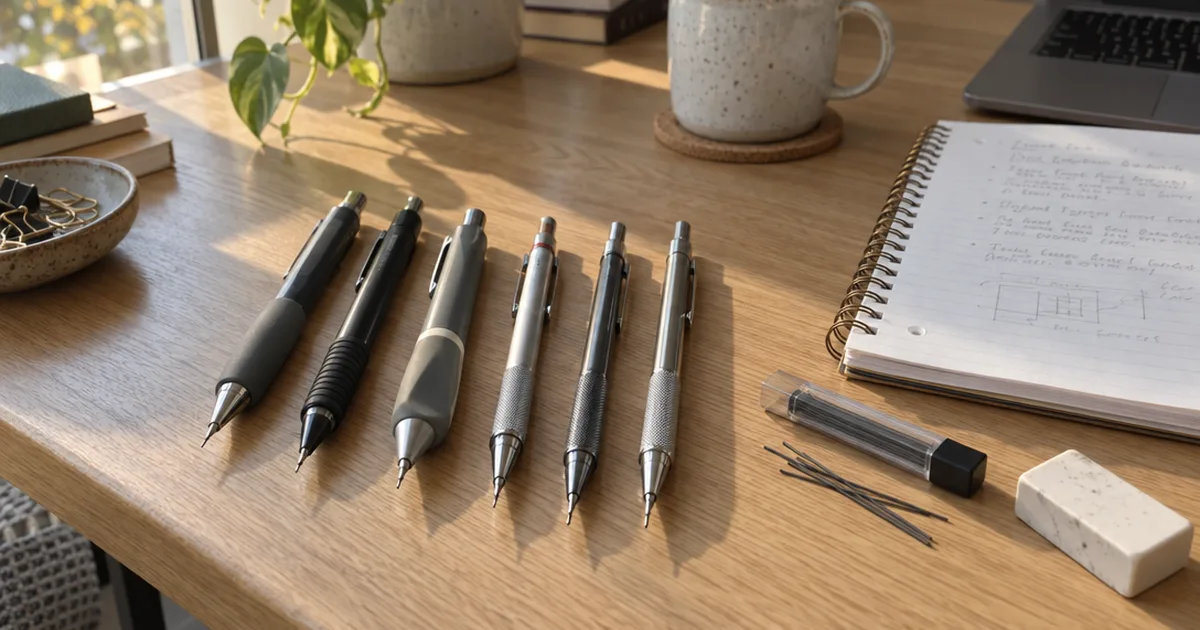
One pencil on this list has 9,156 ratings on Amazon and averages 4.7 stars. Shoppers keep pointing to two things: a comfortable grip and a point that stays sharp on its own.
An ergonomic mechanical pencil should let your hand relax, not clamp a skinny barrel. Clamping is the real problem, as a tight pinch held over a full page starts the ache.
These 7 picks rank by long-session comfort, from cushioned gel grips to balanced metal. Each says who it suits and who should skip it, including heavy hands and sore joints.
Ergonomic Mechanical Pencils Ranked for Comfort
The best ergonomic mechanical pencil is the Uni Alpha-Gel Kuru Toga, with a gel grip and rotating lead. Next come the padded Pilot Dr. Grip and Sakura SumoGrip, then 4 metal ones.
Here’s what each pick was judged on:
- Grip: the diameter, shape and material of the section your fingers touch.
- Pressure: whether the design lets you write with a lighter hold, such as a cushion, knurling or a self-sharpening lead.
- Weight and balance: how the pencil sits in your hand over a long session.
- Lead feeding: whether you can get fresh lead without moving your fingers.
- Proof: what each maker’s listing states, plus the product data on Amazon.
None of these picks was lab-tested by us, so every spec below comes from the maker’s own listing.
Here’s how the 7 pencils compare at a glance:
| # | Product | Our Rating | ||
|---|---|---|---|---|
| 1 |  |
Uni Alpha-Gel Kuru Toga Mechanical Pencil, 0.5 mm | ★★★★☆ | Check Price |
| 2 |  |
Pilot The Dr. Grip Black Accent Mechanical Pencil, 0.5 mm | ★★★★☆ | Check Price |
| 3 |  |
Sakura SumoGrip Ergonomic Mechanical Pencil, 0.7 mm | ★★★★☆ | Check Price |
| 4 |  |
rOtring 800 Mechanical Pencil, 0.5 mm | ★★★★☆ | Check Price |
| 5 |  |
Uni Kuru Toga Roulette Mechanical Pencil, 0.5 mm | ★★★★☆ | Check Price |
| 6 |  |
Everyman Grafton Mechanical Pencil, 0.5 mm | ★★★★☆ | Check Price |
| 7 | 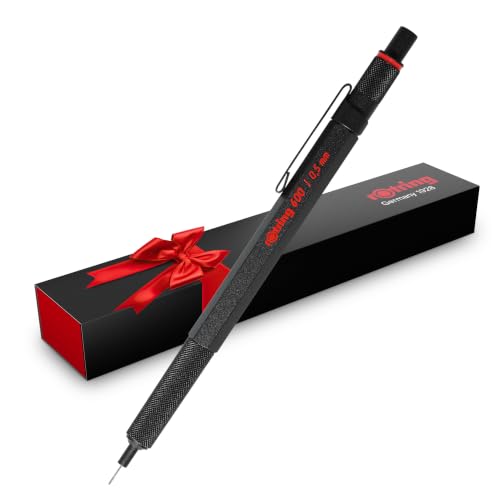 |
rOtring 600 Mechanical Pencil, 0.5 mm | ★★★★☆ | Check Price |
1. Uni Alpha-Gel Kuru Toga Mechanical Pencil, 0.5 mm
Uni Alpha-Gel Kuru Toga Mechanical Pencil, 0.5 mm
A 0.5 mm Kuru Toga pencil that turns its lead a little every time you lift it, wrapped in a soft Alpha-Gel grip from Uni for long writing sessions.
Pros
- Gel grip cushions a tight hold
- Kuru Toga engine keeps the point sharp
- Even lead wear means fewer breaks
- Fine 0.5 mm lines for notes and math
Cons
- Gel can feel squishy if you like a firm hold
- 0.5 mm lead only in this model
The Uni Alpha-Gel Kuru Toga is the best pick for most people who get sore fingers from writing.
It solves 2 problems at once: a hard grip and a dull point.
Compared with the Pilot Dr. Grip at #2, it feels softer under your fingers and keeps its own point sharp, while the Dr. Grip feels firmer and feeds lead with a shake.
- Best for: students, note-takers and anyone who writes for an hour or more at a time.
- Skip it if you like a firm, solid grip that doesn’t give under your fingers.
Start with the grip.
The Alpha-Gel section is soft enough to squish slightly under your fingertips, which spreads the pressure across more of your skin instead of 3 hard contact points.
That matters if you’re a “death grip” writer. A soft section gives you something to sink into, so you’re less tempted to squeeze harder for control.
Now the lead.
The Uni listing on Amazon says the Kuru Toga mechanism twists the lead a little every time you lift the pencil off the page.
That keeps the tip worn evenly into a cone instead of a flat chisel.
Why does that help your hand?
A flat, worn tip writes thick and smudgy, so most people press harder and tilt the pencil to find a sharp edge. The Kuru Toga does the turning for you.
In fact, the same listing claims you end up using only about 50% of the lead area a regular pencil drags across the page, which it says gives thinner lines and less breakage.
Fewer breaks mean fewer interruptions to click, regrip and start again.
Here’s what that looks like in practice:
Say you take 2 hours of lecture notes. With a standard pencil, you’d stop now and then to turn the barrel for a sharper edge or click past a broken tip.
With the Kuru Toga engine, the point keeps itself sharp, so your hand can stay in one relaxed position for page after page.
The catch is the feel. Some writers find gel too soft and slippery for precise work, and the 0.5 mm lead in this model will snap if you bear down hard.
So if you’re heavy-handed, load a break-resistant lead or look at #3.
Key Takeaway: If you only buy one ergonomic mechanical pencil, this is the safest bet for long writing.
2. Pilot The Dr. Grip Black Accent Mechanical Pencil, 0.5 mm
Pilot The Dr. Grip Black Accent Mechanical Pencil, 0.5 mm
A 0.5 mm pencil with a robust silicone grip and a Shake Shake mechanism that feeds lead without moving your fingers.
Pros
- Thick silicone grip cushions your fingers
- Shake feeds lead without regripping
- Grip twist locks the shaker in a bag
- Knock and shake noise cut by half
Cons
- Firmer feel than the Alpha-Gel
- Thick grip can feel bulky in small hands
The Pilot Dr. Grip is the pick if you want cushioning but prefer a firmer grip than the Alpha-Gel.
Its whole design is built around a thick silicone grip and lead that feeds with a shake.
- Best for: long study sessions and writers who hate stopping to click.
- Skip it if you have small hands and like a slim barrel.
The Pilot listing on Amazon describes the grip as “comfortably robust silicone” built to minimize shoulder and arm strain.
That’s the maker’s claim, but the idea is simple: a thicker, padded barrel lets your fingers open up instead of pinching.
Here’s how the Shake Shake mechanism works:
- You write until the lead runs short.
- You give the pencil a quick shake up and down.
- A sliding weight inside clicks the lead forward, and you keep writing without moving your fingers.
That last step is the ergonomic win. Every time you reach for the top button, you break your hold and then rebuild it, often tighter than before.
This newer Black Accent version adds 2 fixes the listing calls out.
First, you twist the grip to lock the shaker, so the lead doesn’t feed itself in a bag or pencil case.
Second, Pilot says knock and shake noise is 50% lower than the previous models, thanks to redesigned parts and springs.
Quieter clicks sound minor. But if you write in lectures, libraries or open offices, it’s the difference between shaking freely and holding back.
In other words, next to #1, pick the Dr. Grip for support and the Alpha-Gel for cushioning.
One habit makes the shaker work better: hold the pencil the way you write, then flick it with a short wrist motion. You don’t need a big shake, and you don’t need to let go.
3. Sakura SumoGrip Ergonomic Mechanical Pencil, 0.7 mm
Sakura SumoGrip Ergonomic Mechanical Pencil, 0.7 mm
A lightweight 0.7 mm pencil with a large triangular rubber cushion grip, an anti-roll clip and a jumbo twist-out eraser.
Pros
- Triangle shape sets fingers without pinching
- Cushy rubber wraps the whole grip
- Very light barrel floats in the hand
- 0.7 mm lead resists snapping
Cons
- Plastic body feels basic
- Thick grip is less precise for fine detail
The Sakura SumoGrip is the pick for sore joints and heavy hands.
It combines the thickest cushion on this list with a light barrel and a stronger 0.7 mm lead.
Next to the Alpha-Gel at #1, the SumoGrip is chunkier and less precise, but it’s the easier pencil to hold if your joints are stiff or swollen.
- Best for: people with arthritis, carpal tunnel or weak grip strength, and anyone who presses hard.
- Skip it if you need fine detail work, where a fat grip and thicker lead get in the way.
The Sakura listing describes a “large cushy comfort grip” wrapped around a lightweight barrel that “floats in your fingers.”
The shape matters as much as the padding.
The grip is a triangle, not a circle.
Each flat side gives your thumb, index finger and middle finger its own spot, so your fingers settle into place instead of rolling around the barrel and squeezing to hold it still.
The Sakura listing on Amazon for the 3-pack goes further.
It says SumoGrip pencils are “recommended by physical therapists” and “excellent for carpal tunnel patients and adults with fine motor skill difficulty.”
That’s marketing copy from the maker, so treat it as a claim, not a clinical finding.
The 0.7 mm lead is the quiet hero here.
Thicker lead is harder to snap, and every snapped lead is a small jolt that teaches your hand to grip tighter.
With 0.7 mm, you can write with normal pressure and stop bracing for breaks.
Here’s a quick checklist to see if the SumoGrip fits you:
- Your knuckles turn white when you write.
- Thin pencils leave a dent in your middle finger.
- You break 0.5 mm lead more than once a page.
- You want a big eraser that twists out instead of a tiny plug.
If 2 or more sound familiar, start here.
The SumoGrip also comes in 0.5 mm and 0.9 mm versions on Amazon, so you can pick a finer line or an even stronger lead without giving up the same cushioned grip.
The same 3-pack listing says the jumbo twist eraser lasts 6 times longer than an average pencil eraser.
4. rOtring 800 Mechanical Pencil, 0.5 mm
rOtring 800 Mechanical Pencil, 0.5 mm
A full-metal 0.5 mm pencil with a knurled grip, a brass mechanism and a twist-and-click tip that retracts for pocket carry.
Pros
- Balanced metal weight steadies the hand
- Knurled grip holds without squeezing
- Tip retracts so it never bends in a bag
- Hexagonal barrel will not roll away
Cons
- Hard metal grip has no cushion
- Heavier than plastic picks
The rOtring 800 is the best pick if you want a metal pencil that stays comfortable for long sessions.
It trades cushioning for balance and a grip that holds without squeezing.
- Best for: writers and sketchers who like a solid, weighty pencil and dislike rubber grips.
- Skip it if your joints hurt, since hard metal has no give at all.
rOtring, the German maker behind this pencil, describes the 800 as a full metal body with “balanced weight for control and comfort.”
The listing also says the hexagonal barrel is designed to support fatigue-free writing and drawing.
Why would a heavier pencil feel easier?
Some of the pencil’s weight does the work of pressing the lead to the paper, so you need less downward force.
And a balanced pencil doesn’t tip forward or back, so your fingers don’t have to fight it.
Then there’s the grip.
The 800 uses a knurled grip, a pattern of tiny raised diamonds cut into the metal. That texture holds your fingertips so the pencil doesn’t slide, even with a lighter hold.
The headline feature is the twist-and-click tip.
Twist the front and the whole sleeve retracts into the body.
So you can drop it in a pocket or bag without bending the tip, then twist it back out with a fixed sleeve that gives you a clear line of sight along a ruler.
Compared with the rOtring 600 at #7, the 800 keeps the same brass mechanism and adds that retracting tip.
Want metal without the cold, hard feel? Wrap the knurled section with a slip-on rubber grip.
You’ll lose some of the precision, but you’ll keep the balance.
5. Uni Kuru Toga Roulette Mechanical Pencil, 0.5 mm
Uni Kuru Toga Roulette Mechanical Pencil, 0.5 mm
A light 0.5 mm Kuru Toga with a ribbed metal grip and the same self-rotating lead engine, rated 4.7 out of 5 on Amazon.
Pros
- Light enough for hours of notes
- Rotating lead keeps lines even
- Ribbed grip adds hold without rubber
- Thousands of positive Amazon ratings
Cons
- Slim barrel for people who need width
- No cushioning on the grip
The Uni Kuru Toga Roulette is the pick for writers who want a light pencil with the self-sharpening lead from #1.
It has thousands of Amazon ratings, and the review summary keeps coming back to comfort.
- Best for: long note-taking, math and anyone who wants a light metal-gripped pencil.
- Skip it if you need a thick barrel, since this one is slim.
The Amazon listing for the Kuru Toga Roulette shows 4.7 out of 5 stars from 9,156 global ratings as of November 2026.
That’s a lot of hands agreeing.
The same listing summarizes those reviews this way: customers find it a high-quality writing tool whose rotating lead mechanism keeps it sharp while writing.
They also single out its ergonomic design, comfortable grip and solid construction that feels substantial in hand.
So how light is it?
The listing gives an item weight of 13.61 g and Japan as the country of origin. That weight is light enough that your fingers aren’t holding up much weight hour after hour.
The grip is ribbed metal rather than gel. You get traction without cushioning, which suits writers who hold a pencil lightly but still want it to stay put.
Here’s the trade-off versus #1: same Kuru Toga engine, but a slimmer, firmer grip.
Uni says that engine rotates the core little by little while you write, so your lines keep a constant thinness and density.
If you write fast and light, the Roulette may actually feel better than the Alpha-Gel, because there’s no soft layer between you and the barrel.
6. Everyman Grafton Mechanical Pencil, 0.5 mm
Everyman Grafton Mechanical Pencil, 0.5 mm
An aluminum pencil with deep grip grooves and balanced weight, built to take 0.5 mm or 0.7 mm lead.
Pros
- Deep grooves give control without rubber
- Balanced weight from tip to cap
- Takes 0.5 mm or 0.7 mm lead
- Durable aluminum body
Cons
- No cushioned grip section
- Heavier than plastic pencils
The Everyman Grafton is the pick for writers who want a sturdy aluminum pencil with built-in grip texture.
It sits between the cushioned picks and the rOtrings: metal, but with deep grooves instead of fine knurling.
Against the rOtring 800 at #4, the Grafton swaps the retracting tip for lead flexibility, since it takes 2 lead sizes instead of 1.
- Best for: everyday carry, sketching and drafting.
- Skip it if you need padding on the grip.
The Everyman listing on Amazon says the Grafton has “deeper grooves for enhanced control and precision” and is made from aluminum.
Those grooves are the ergonomic feature.
They give your fingertips ridges to rest against, so the pencil stays put without a tight pinch. That’s useful if knurling feels too sharp on your skin.
The listing also highlights “balanced weight distribution for optimal comfort and control.”
A pencil that’s balanced near the middle of your grip feels lighter than its weight, because it doesn’t pull your hand toward the tip or the cap.
The other selling point is lead choice.
The same listing says the Grafton works with both 0.5 mm and 0.7 mm lead. So you can start with 0.5 mm for notes, then switch to 0.7 mm if you find yourself snapping lead.
In other words, the Grafton is a metal pencil that adapts to how hard you press.
7. rOtring 600 Mechanical Pencil, 0.5 mm
rOtring 600 Mechanical Pencil, 0.5 mm
A classic all-metal 0.5 mm drafting pencil with a knurled grip, hexagonal barrel, fixed lead sleeve and lead-grade indicator.
Pros
- Fixed sleeve gives a clear view at rulers
- Non-slip knurled grip for long sessions
- Brass mechanism advances lead evenly
- Hexagonal barrel will not roll off a desk
Cons
- Slim metal barrel, no cushioning
- Eraser hides under a small cap
The rOtring 600 is the pick for drafting, technical drawing and ruler work.
Its fixed tip gives the clearest view on this list of the line you’re drawing.
- Best for: engineers, architects and artists who need precise lines at a ruler or template.
- Skip it if comfort for hours of handwriting is your main goal, since #1 to #4 do that better.
The rOtring listing describes a full metal body with a “non-slip knurled metal grip” for “excellent balance and fatigue-free control for extended drawing or writing sessions.”
The fixed lead sleeve is the key difference from the 800.
The sleeve sticks out past the cone, so you can run the pencil along a straightedge and see exactly where the lead meets the paper.
That clear view is an ergonomic feature too. When you can see the tip, you don’t hunch over or twist your wrist to check your line.
The hexagonal barrel keeps the 600 from rolling off a tilted drafting table, and a lead-grade indicator shows which hardness is loaded.
The listing also mentions a hidden eraser under the push-button cap for quick fixes.
The catch is that fixed sleeve. It doesn’t retract, so it can bend if you drop the pencil tip-first or carry it loose in a pocket.
So if you travel with your pencil, step up to the 800 at #4.
But if your pencil lives on a desk and you draw at a ruler most days, the 600 gives you the same metal balance and brass mechanism in a simpler body.
What Makes a Mechanical Pencil Ergonomic?
An ergonomic mechanical pencil lets you write with a relaxed hand, mainly through a wider or softer grip, balanced weight and a way to feed lead without changing your hold.
A regular mechanical pencil is built for precision, not comfort.
Its thin, hard barrel works fine for a few lines. But over a full page, it pushes most people into a tighter pinch, and that pinch is where the ache starts.
Here are the 4 features that change how a pencil feels:
- Grip size and shape: a thicker or triangular section lets your fingers open up instead of curling tightly.
- Grip material: silicone, gel and rubber cushion your fingertips; knurled or grooved metal adds traction without padding.
- Weight and balance: a balanced pencil doesn’t tip in your hand, so your fingers stop making small corrections.
- Lead feeding: shake mechanisms, like the one on the Pilot Dr. Grip, feed lead without moving your fingers.
A self-rotating lead, like the Uni Kuru Toga engine, is a bonus fifth feature. It keeps the point sharp, so you don’t press harder to get a clean line.
So when you shop, check the grip first, then the weight, then the lead mechanism.
Is a Heavier or Lighter Mechanical Pencil Better for Hand Fatigue?
A lighter mechanical pencil is usually better for long writing sessions.
A heavier, balanced metal pencil can help writers who press hard by letting the pencil’s weight do some of the pressing.
There’s no single right weight. It depends on what tires your hand out.
If your fingers get tired from holding the pencil up, go light.
The Uni Kuru Toga Roulette (#5) lists an item weight of 13.61 g on Amazon, which is about as light as a metal-gripped pencil gets.
If your hand gets tired from pressing down, a heavier pencil can help.
A metal body like the rOtring 800 (#4) rests more of its weight on the lead. That means you can ease off the downward force and let gravity help.
But there’s a catch:
Heavy pencils can wear out your fingers if you also grip tightly. You end up squeezing a heavier object for longer, which is the opposite of what you want.
Here’s a simple way to decide:
- You write quickly for hours, like lecture notes: pick a light pencil such as #1, #3 or #5.
- You draw or write slowly and press hard: try a balanced metal pencil such as #4 or #6.
- You have arthritis or joint pain: start light and cushioned, then add weight only if you find you’re pressing too hard.
Balance matters more than raw weight.
A pencil that’s heavy at the cap pulls your hand backward, while one balanced near the grip feels lighter than it is.
Everyman says the Grafton (#6) is built with balanced weight distribution for exactly this reason.
Is a Thicker Pencil Grip Better for Your Hand?
A thicker pencil grip is better for most adults who get sore fingers, because a wider barrel lets your fingers rest in a more open position and reduces the need to pinch tightly.
The right thickness depends on your hand size.
Too thin, and your fingertips curl in hard to hold the barrel. Too thick, and your fingers spread so wide that you lose control and start gripping harder to steady the tip.
The 3 cushioned picks on this list cover the range:
- Uni Alpha-Gel Kuru Toga (#1): moderate thickness with a soft gel layer.
- Pilot Dr. Grip (#2): a thick silicone grip that fills more of your hand.
- Sakura SumoGrip (#3): a thick triangular cushion that sets each finger in place.
Shape counts too.
A triangular grip like the one on the SumoGrip gives each of your 3 gripping fingers its own flat side.
So your fingers don’t slide, and you don’t need extra pressure to stop the pencil from rolling.
Here’s a 2-minute test you can do with any pencil you own:
- Write 5 lines at your normal speed.
- Stop and look at your fingertips and knuckles.
- If your knuckles are white or your middle finger has a deep dent, the grip is too thin or too hard for you.
If that happens with a slim pencil, move up to a cushioned grip.
And if you already own a pencil you like, a slip-on rubber grip can add thickness without buying a new pencil.
Pilot Dr. Grip vs Uni Kuru Toga Alpha Gel: Which Is More Comfortable?
The Uni Kuru Toga Alpha Gel is more comfortable if you want the softest, most cushioned grip.
The Pilot Dr. Grip is more comfortable if you prefer a firmer, thicker grip that feels supportive rather than squishy.
Both are built for long writing sessions. They just get there in different ways.
Here’s how they compare on what matters to your hand:
- Grip feel: the Alpha-Gel is soft gel; the Dr. Grip is firmer silicone.
- Lead feeding: the Alpha-Gel uses a push button; the Dr. Grip feeds by shake or button.
- Lead point: the Alpha-Gel rotates its lead to stay sharp; the Dr. Grip uses a standard point.
- Bag safety: the Dr. Grip twists to lock its shaker; the Alpha-Gel has no shaker to lock.
- Lead size: both versions on this list take 0.5 mm lead.
So which should you buy?
If you squeeze hard and want something to sink into, get the Alpha-Gel. Its soft layer absorbs the pressure from a tight hold.
If soft grips feel unstable or make your fingers sweat, get the Dr. Grip. Its firmer silicone keeps the pencil steady while still cushioning your fingers.
And if you can’t decide, think about how you write.
Constant, fast note-taking favors the Dr. Grip, since you never stop to click.
Neat handwriting and math favor the Alpha-Gel, since the rotating lead keeps your lines thin and even.
Do Shaker Mechanical Pencils Reduce Hand Strain?
Shaker mechanical pencils can reduce hand strain a little by letting you feed lead without breaking your grip, but the grip itself matters far more than the shake mechanism.
Here’s why the shaker helps:
Every time you reach for a top button, you lift your thumb or shift the pencil, then rebuild your hold.
Many people regrip tighter than before, especially when they’re writing fast.
A shaker skips that step. You flick the pencil and keep writing with your fingers right where they were.
Pilot pitches the Dr. Grip (#2) on less arm and shoulder strain, but that’s the maker’s claim, not an independent test.
But a shaker on a thin, hard pencil won’t fix sore fingers.
If the grip forces you to pinch, you’ll still pinch, whether the lead feeds by shaking or by clicking.
So use this order when you shop:
- Get a grip that fits your hand.
- Then pick a light or balanced weight.
- Then add a shaker if you write long, fast stretches.
The bottom line? Treat the shaker as a convenience that protects your grip, not a cure on its own.
What Lead Size Is Best for an Ergonomic Mechanical Pencil?
The best lead size for an ergonomic mechanical pencil is 0.7 mm for most people who press hard or write for hours, while 0.5 mm suits lighter writers who want finer lines.
Lead size changes how you hold the pencil more than most people realize.
Thin graphite lead snaps easily. And when lead snaps over and over, your hand learns to brace for it, which usually means a tighter grip and slower, stiffer strokes.
Here’s a simple guide:
- 0.5 mm: the standard size. Good for notes, math and neat handwriting if you write with a light touch.
- 0.7 mm: stronger and smoother. Better if you break 0.5 mm lead or have arthritis and can’t control pressure well.
- 0.9 mm and up: very strong and bold. Good for heavy hands, but less precise for small writing.
The Sakura SumoGrip (#3) on this list uses 0.7 mm. The Everyman Grafton (#6) takes either 0.5 mm or 0.7 mm, so you can switch without buying a new pencil.
What if you love a 0.5 mm pencil but keep breaking lead?
Try a self-rotating pencil like the Uni Kuru Toga picks (#1 and #5). The Uni listing says the rotating lead wears more evenly and breaks less than a standard 0.5 mm pencil.
One more tip: always put the right size lead in your pencil. The wrong size can jam the mechanism and leave you forcing the button.
Best Mechanical Pencils for Arthritis and Carpal Tunnel
The best mechanical pencils for arthritis and carpal tunnel are the Sakura SumoGrip and the Uni Alpha-Gel Kuru Toga.
Both pair a thick, cushioned grip with a lightweight body that lets you write without squeezing.
Both conditions make a tight pinch uncomfortable.
So the goal is a pencil that lets your fingers relax, rests lightly in your hand and doesn’t make you press hard.
Here’s how the picks line up for sore joints:
- Sakura SumoGrip (#3): the thickest cushion, a triangle shape and 0.7 mm lead. Sakura markets it as recommended by physical therapists for carpal tunnel.
- Uni Alpha-Gel Kuru Toga (#1): the softest grip, plus a rotating lead that lets you write lightly.
- Pilot Dr. Grip (#2): a firmer cushioned grip with a shaker, if soft gel feels unstable.
The metal picks (#4, #6 and #7) are a poor first choice here.
Hard metal has no give, so all the pressure lands on the same small spots on your fingers.
Note: A pencil can make writing more comfortable, but it can’t treat arthritis or carpal tunnel.
If you have numbness, tingling or pain that doesn’t ease with rest, see a doctor or a hand therapist.
Your desk setup matters too.
Resting your forearm on an ergonomic arm support or a cushioned wrist rest takes load off your wrist while you write.
And if your mouse hand hurts as much as your writing hand, look at mice built for carpal tunnel relief.
How to Hold a Mechanical Pencil to Avoid Hand Cramps
To avoid hand cramps, hold a mechanical pencil with a relaxed tripod grip.
The barrel rests on your middle finger, your thumb and index finger guide it lightly, and you move it with your forearm rather than just your fingers.
The pencil matters, but your hold matters just as much.
Here’s how to set up a relaxed grip:
- Rest the pencil on the side of your middle finger. This finger carries the weight, so your thumb and index finger don’t have to.
- Place your thumb and index finger on opposite sides of the grip. They should guide the pencil, not clamp it.
- Hold the grip section, not the tip. Holding higher on the barrel gives you a lighter, looser hold.
- Move from your forearm. Let your arm glide across the page so your fingers aren’t doing every stroke.
- Take short breaks. Every so often, set the pencil down, open your hand and shake out your fingers.
Here’s a quick check: loosen your hold until the pencil almost slips, then tighten just enough to write. That’s your target pressure.
The same relaxed tripod grip works with a ballpoint or a fountain pen, so the habit pays off whatever you write with.
Your setup helps too. Good light from an adjustable desk lamp means you don’t lean in and tense up to see your page.
A desk at the right height, like an ergonomic student desk, keeps your elbow open and your wrist straight.
Keep your pencils within reach in a pencil holder, so you aren’t twisting to grab one mid-sentence.
Other ergonomic desk accessories work the same way, cutting small reaches and awkward angles out of your writing time.
The thicker, softer grip rule carries over to other tools too: an ergonomic stylus applies it on a tablet, and an oblique pen holder applies it to calligraphy.
And if your grip feels weak, a hand exerciser is a simple way to work on grip strength between writing sessions.
Frequently Asked Questions
What is the most comfortable mechanical pencil for long writing sessions?
The Uni Alpha-Gel Kuru Toga is the most comfortable mechanical pencil for long writing sessions on this list, because its soft gel grip cushions a tight hold and its rotating lead keeps the point sharp.
If you prefer a firmer feel, the Pilot Dr. Grip adds a thick silicone grip and lead that feeds with a shake.
Are metal mechanical pencils bad for your hands?
Metal mechanical pencils aren’t bad for your hands, but their hard grips have no cushioning, so they suit light-handed writers better than people with arthritis or carpal tunnel.
If you like metal, pick a balanced one with a knurled or grooved grip, such as the rOtring 800.
Is the Kuru Toga Alpha Gel worth it?
The Uni Alpha-Gel Kuru Toga is worth it if you write for long stretches and squeeze your pencil, because it combines a soft gel grip with the Uni self-rotating lead.
If you write lightly and want a slimmer pencil, the Kuru Toga Roulette gives you the same lead engine in a 13.61 g metal-gripped body.
What is the best mechanical pencil for students?
The Pilot Dr. Grip is a strong mechanical pencil for students, since its shake-to-feed lead keeps you writing through long lectures and its grip twists to lock the shaker in a backpack.
Students who write neat math and notes may prefer the Uni Alpha-Gel Kuru Toga for its always-sharp point.
Which ergonomic mechanical pencil is best for drawing?
The rOtring 600 is the best ergonomic mechanical pencil on this list for drawing and drafting, because its fixed lead sleeve gives a clear view of the line at a ruler.
For long sketching sessions on the go, the rOtring 800 adds a tip that retracts into the body.
Can you make a regular mechanical pencil more ergonomic?
Yes, you can make a regular mechanical pencil more ergonomic by sliding on a soft rubber or foam grip, which thickens the barrel and cushions your fingers.
Switching to 0.7 mm lead also helps, since it snaps less often and lets you write with a lighter hold.
Do ergonomic mechanical pencils really help hand pain?
Ergonomic mechanical pencils can make writing more comfortable by letting you hold the pencil with less pressure, but they don’t treat the cause of hand pain.
See a doctor or hand therapist if numbness, tingling or pain keeps coming back.
Final Thoughts
Grip comfort decided this list more than anything else, and the Uni Alpha-Gel Kuru Toga handles it best by cushioning your fingers and keeping the point sharp.
If your hands already hurt, start with a cushioned pick like #1, #2 or #3 before you try a metal pencil.
This week, write a full page with the pencil you own now and check your knuckles. If they turn white, it’s time to switch.