4 of these 7 trackpads list Windows as their only operating system.
So the computer on your desk settles most of this choice before any feature does.
Below are the 7 best trackpad picks for a desk, rated on surface, connections, battery and click feel, and each one says who it suits and who should skip it.
Here’s the fast way to pick:
- On a Mac, nothing here matches #1.
- A Windows laptop plus a desktop PC fits #2 or #6.
- Switching between a MacBook and a Windows machine points to #3 or #4.
- Hate charging anything? Go with #7.
Quick Comparison Chart
| # | Product | Our Rating | ||
|---|---|---|---|---|
| 1 |  |
Apple Magic Trackpad (USB-C) | ★★★★★ | Check Price |
| 2 | 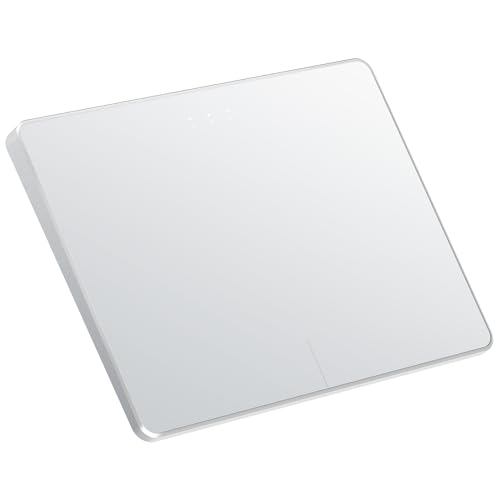 |
ProtoArc T1 Plus Wireless Trackpad | ★★★★☆ | Check Price |
| 3 |  |
Polarmeta Wireless Trackpad | ★★★★☆ | Check Price |
| 4 |  |
MICROPACK Tri-Mode Wireless Trackpad | ★★★★☆ | Check Price |
| 5 |  |
Tacti Trix Wireless Trackpad | ★★★★☆ | Check Price |
| 6 |  |
Amazon Basics Multi-Touch Trackpad | ★★★★☆ | Check Price |
| 7 | 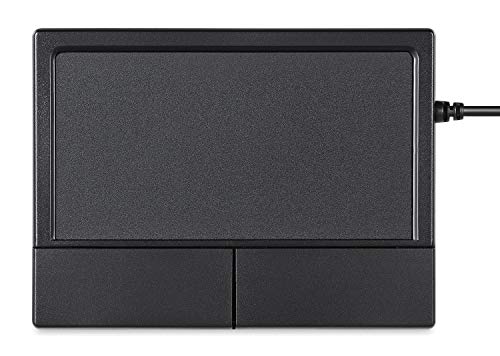 |
Perixx PERIPAD-504 Wired Touchpad | ★★★★☆ | Check Price |
How to Choose the Right Trackpad
Choose a trackpad by checking three things in order: the operating systems it lists, how it connects (Bluetooth, a 2.4GHz receiver or a cable), and whether it clicks with physical buttons or pressure zones.
I rated every pick on these factors:
- Listed system support: Windows, macOS or iPadOS
- Surface size and material, from glass to aluminum to plastic
- Connection type: Bluetooth, a 2.4GHz USB receiver or a cable
- Battery life per charge, from each maker’s own listing
- Click type: physical buttons, pressure zones or haptic feedback
These ratings come from the makers’ specs and listings, not lab testing.
Start with your computer. The ProtoArc, Tacti Trix and Amazon Basics listings all rule out Mac, Chrome OS or Linux, so none of them can stand in for a Magic Trackpad on a MacBook.
Next, pick a connection. A USB cable never needs charging, a wireless pad frees up a port, and a 2.4GHz receiver gives Mac users full gestures on the two cross-platform pads (#3 and #4).
Then decide how you like to click. Physical left and right buttons (#2, #6 and #7) give a firm click you can feel, while pressure zones (#1 and #5) let one flat surface do the work.
If you’re rebuilding your whole ergonomic office setup, choose the trackpad and an ergonomic keyboard together so both fit side by side. And if you’d rather keep everything on one board, look at keyboards with a built-in touchpad instead.
1. Apple Magic Trackpad (USB-C)
Apple Magic Trackpad (USB-C)
A wireless, rechargeable glass trackpad with Force Touch pressure sensing and the full set of Multi-Touch gestures, built for Mac, iPad and Apple Vision Pro.
Pros
- Pairs automatically with a Mac
- Sensors read how hard you press
- Large edge-to-edge glass surface
- Charges over USB-C
- Runs about a month or more per charge
Cons
- Listing names Mac, iPad and Vision Pro, not Windows
- No multi-device switch button listed
The Apple Magic Trackpad (USB-C) is the closest thing to a MacBook Pro trackpad you can put on a desk.
Best for: Mac mini, iMac and MacBook Pro owners who work on a big external monitor. Skip it if your main computer runs Windows.
The Amazon listing says it includes the full range of Multi-Touch gestures plus Force Touch, where sensors under the glass read how hard you press. Because it can tell a light press from a firm one, the same glass can trigger different actions without extra buttons.
Battery life is the other big win. The listing rates it at about a month or more between charges.
Compared with the Polarmeta (#3), you get native macOS gestures and automatic pairing, while the Polarmeta adds Windows support.
Note: The listing names Mac, iPad and Apple Vision Pro only, so Windows users should look at #2 instead.
If your computer is a Mac, this is the trackpad to buy.
2. ProtoArc T1 Plus Wireless Trackpad
ProtoArc T1 Plus Wireless Trackpad
A 6.4-inch aluminum wireless trackpad for Windows 10 and 11 with physical left and right click buttons and one-button switching between three devices.
Pros
- Switches between 3 devices
- Physical left and right click buttons
- Up to four-finger gestures
- About 50 hours per charge
- No drivers to install
Cons
- Windows 10 and 11 only
- Bluetooth only, no wired mode
The ProtoArc T1 Plus Wireless Trackpad is the Windows answer to the Magic Trackpad, and it’s the right pick for most PC desks.
Best for: Windows 10 and 11 users who move between a laptop, a desktop and a tablet. Skip it if you want a cable connection or use a Mac.
The ProtoArc store page lists a 6.4-inch multi-touch surface, physical left and right click buttons and up to four-finger gestures. The same page rates its 500mAh battery at about 50 hours of use and says it needs no drivers.
Switching between computers works like this:
- Pair each device to its own Bluetooth channel, up to three in total.
- Press the mode switch button to jump to the next device.
- Set cursor speed in Windows Settings under Bluetooth & other devices, then Touchpad, since the pad has no DPI button.
One quirk to know: if you turn off a laptop’s built-in touchpad, the listing warns that an external touchpad will usually stop working too.
Next to the Amazon Basics pad (#6), it holds three devices instead of two, though the Amazon Basics adds a wired mode.
For a Windows PC, the T1 Plus gives you the most for the least fuss.
3. Polarmeta Wireless Trackpad
Polarmeta Wireless Trackpad
A 7.5-inch frosted glass trackpad that works on macOS and Windows 10/11 through a 2.4G USB receiver, with a physical click and an aluminum body.
Pros
- Largest surface on this list at 7.5 inches
- Works on macOS and Windows 10/11
- Physical click plus tap to click
- Use it while it charges over USB-C
- Anti-slip rubber base
Cons
- Receiver only, no Bluetooth
- About 7 days per charge
The Polarmeta Wireless Trackpad is the rare big glass pad that runs on both macOS and Windows.
Best for: anyone who switches between a MacBook and a Windows PC at one desk. Skip it if you need Bluetooth.
The Amazon listing gives it a 7.5-inch frosted glass surface, the largest on this list, plus a physical click and tap to click. It connects through a 2.4G USB receiver with no drivers, so it works the moment you plug it in on either system.
Here’s the battery math. The 900mAh battery lasts up to 7 days of typical use, recharges in about 2 hours over USB-C, and keeps working while the cable is plugged in.
The catch? Without Bluetooth, the receiver has to move with you each time you change computers.
Against the MICROPACK (#4), you trade Bluetooth and iPad support for more glass and an aluminum body with an anti-slip rubber base.
Pick the Polarmeta if you want one large glass surface for a Mac and a PC.
4. MICROPACK Tri-Mode Wireless Trackpad
MICROPACK Tri-Mode Wireless Trackpad
A light tri-mode touchpad that connects by Bluetooth 5.0, a 2.4GHz USB receiver or USB-C cable, and lists Windows, macOS and iPadOS support.
Pros
- Three ways to connect
- Mode button switches devices
- Up to five-finger gestures
- Light at 145g for travel
- 7 to 10 days per charge
Cons
- Bluetooth may register as a Magic Mouse on Mac
- Matte ABS surface, not glass
The MICROPACK Tri-Mode Wireless Trackpad connects three ways, which makes it the most flexible pad here for mixed setups.
Best for: travelers and anyone who uses a Windows laptop, a Mac and an iPad. Skip it if you want a glass surface.
The Amazon listing covers a lot in a small package:
- Bluetooth 5.0, a 2.4GHz USB-A receiver and a USB-C cable
- Windows 8 and later, macOS and iPadOS 13 or later
- Up to five-finger gestures
- A 500mAh battery that charges in 2 to 3 hours and lasts 7 to 10 days
- A 142 x 108 x 11 mm body that weighs 145g
On Apple devices, connect it by cable or receiver. The listing warns that over Bluetooth, macOS and iPadOS may treat it as a Magic Mouse, which can block gesture mapping.
Compared with the Polarmeta (#3), it’s lighter and adds Bluetooth, but its surface is matte plastic instead of glass.
For a bag that holds three devices, the MICROPACK is the one pad that talks to all of them.
5. Tacti Trix Wireless Trackpad
Tacti Trix Wireless Trackpad
A Windows 10/11 glass trackpad in a thin metal body with pressure-sensitive click zones, switchable haptic feedback and three connection modes.
Pros
- Pressure zones with haptic feedback you can turn off
- Bluetooth 5.0, 2.4G or USB-C cable
- USB to USB-C adapter included
- Up to 50 hours per charge
- Up to four-finger gestures
Cons
- Windows 10 and 11 only
- No physical left and right buttons
The Tacti Trix Wireless Trackpad is for Windows users who want a click that feels closer to a MacBook than to a mouse button.
Best for: Windows 10 and 11 users who like a smooth glass surface and haptic clicks. Skip it if you want physical buttons or use a Mac.
Instead of left and right buttons, the Amazon listing describes pressure-sensitive zones with haptic feedback you can turn on or off. It connects by Bluetooth 5.0 (one device at a time), a 2.4G receiver or a USB-C cable, and a USB to USB-C adapter comes in the box.
The 6.3 x 4.7-inch glass sits in an ultra-thin metal body, and the 500mAh battery runs up to 50 hours per charge.
If haptics matter most to you, the HyperSpace Trackpad Pro is the premium Windows option. A WIRED hands-on review in October 2025 found it entirely haptic, like the Magic Trackpad, with a 240-Hz report rate.
WIRED also reported a Kickstarter launch on October 14, 2025, with official sales planned for the first quarter of 2026. Its reviewer could not get the pad working on a MacBook, so treat it as Windows-only for now.
Next to the ProtoArc T1 Plus (#2), the Tacti Trix swaps physical buttons for haptic zones and adds a cable mode.
Choose the Tacti Trix if a soft, button-free click is what you’re after.
6. Amazon Basics Multi-Touch Trackpad
Amazon Basics Multi-Touch Trackpad
A slim 6.4-inch rechargeable Windows touchpad that holds two devices at once, with built-in left and right buttons.
Pros
- Mode button jumps between two devices
- Built-in left and right buttons
- Up to four-finger gestures
- Wired mode for instant response
- Indicator lights show the mode
Cons
- Windows only
- Sleeps in Bluetooth mode after inactivity
The Amazon Basics Multi-Touch Trackpad keeps two Windows computers on one pad with a single button.
Best for: a work laptop and a home PC that share one desk. Skip it if you use a Mac or need three devices.
Say your work laptop sits next to your home desktop. You pair each one, then press the mode switch to jump between them without re-pairing.
The 6.4-inch pad has built-in left and right buttons, up to four-finger gestures and a USB-C rechargeable battery.
In Bluetooth mode it sleeps after a period of inactivity. If you only use it now and then, the listing recommends wired mode so it responds instantly.
Compared with the ProtoArc T1 Plus (#2), it handles one fewer device but gives you a wired fallback.
For two Windows machines and one pad, this is the simple fix.
7. Perixx PERIPAD-504 Wired Touchpad
Perixx PERIPAD-504 Wired Touchpad
A plug-in USB touchpad for Windows 7 through 11, about 4.7 x 3.5 inches overall, with a 12-month limited warranty and no battery to charge.
Pros
- Never needs charging
- Uninterrupted wired connection
- Works on Windows 7, 8, 10 and 11
- Compact enough to carry
- 12-month limited warranty
Cons
- Smallest surface on this list
- Cable ties it to one computer
The Perixx PERIPAD-504 Wired Touchpad plugs into a USB port and never needs a charge.
Best for: one desktop PC at a fixed desk, including older Windows 7 and 8 machines. Skip it if you want a big surface or wireless freedom.
The Amazon listing puts its overall size at 4.7 x 3.5 x 0.7 inches, small enough to sit beside a keyboard or slip into a laptop bag. It handles the core Windows touch gestures: select, scroll, zoom in or out and show more commands, like a right-click.
To change cursor speed, the listing says to adjust the mouse sensitivity in your computer settings. Perixx backs it with a 12-month limited warranty.
If your wrist ends up on a hard desk edge, a padded wrist rest in front of the pad can help.
Compared with the ProtoArc T1 Plus (#2), it’s smaller and tied to one computer, but it never runs out of battery.
Not sold on trackpads at all? A trackball mouse, one of these other mouse alternatives or a well-shaped ergonomic mouse may suit your hand better.
And if your wrist already aches, compare the picks for an ergonomic mouse for wrist pain before you commit to any pointing device.
For a desk that never moves, wired is the zero-maintenance choice.
Frequently Asked Questions
What is the best trackpad for Windows?
The ProtoArc T1 Plus is the best trackpad for most Windows 10 and 11 PCs, with a 6.4-inch surface, physical click buttons and switching between three devices. If you’d rather click with haptic pressure zones than buttons, the Tacti Trix (#5) is the alternative.
What is the best trackpad for Mac?
The Apple Magic Trackpad (USB-C) is the best trackpad for a Mac because it pairs automatically and supports the full set of Multi-Touch gestures plus Force Touch. It runs about a month or more per charge.
Can you use an Apple Magic Trackpad on a Windows PC?
The Apple Magic Trackpad is sold for Apple devices: its Amazon listing names Mac, iPad and Apple Vision Pro, not Windows. For a Windows PC, a Windows-native pad such as the ProtoArc T1 Plus gives full gesture support with no drivers to install.
Is a trackpad the same as a touchpad?
Yes, a trackpad and a touchpad are the same kind of device, and WIRED notes that trackpad is simply the name Apple uses for a touchpad. Makers use both words, so search for either one when you shop.
Should I get a wired or wireless trackpad?
A wireless trackpad suits most desks because a wireless link keeps the cable out of the way, while a wired pad never needs charging. ProtoArc describes its wired T1 as stable, with zero latency and no batteries, so go wired for a desktop that never moves.
Is there an external trackpad that works on both Mac and Windows?
Yes, the Polarmeta Wireless Trackpad and the MICROPACK Tri-Mode Wireless Trackpad both list macOS and Windows support. On a Mac, connect either one through its USB receiver or cable, since the MICROPACK listing warns that Bluetooth may register it as a Magic Mouse.
Can one trackpad switch between multiple computers?
Yes, the ProtoArc T1 Plus switches between three devices with one button, and the Amazon Basics Multi-Touch Trackpad switches between two. The MICROPACK Tri-Mode Wireless Trackpad also has a mode button for moving between its connections.
How long does a wireless trackpad battery last?
A wireless trackpad battery lasts from about 50 hours of use to about a month per charge, depending on the model. The Magic Trackpad runs about a month or more, the Polarmeta up to 7 days, and the ProtoArc T1 Plus and Tacti Trix about 50 hours each.
Is the HyperSpace Trackpad Pro a good Magic Trackpad alternative for Windows?
The HyperSpace Trackpad Pro is the closest Windows match to the Magic Trackpad on paper, since a WIRED hands-on found it entirely haptic with a 240-Hz report rate. WIRED reported official sales starting in the first quarter of 2026 after a Kickstarter, and its reviewer could not get it working on a Mac.
Why are Apple trackpads so much better?
Apple trackpads set the standard because Apple was the first to make the touchpad truly good and kept adding features such as multi-finger gestures and haptic feedback, according to WIRED. The same review says Windows alternatives have struggled to keep up.
Final Thoughts
Your computer makes most of this decision: the Magic Trackpad on a Mac, the ProtoArc T1 Plus on Windows.
If one desk holds both systems, the Polarmeta or the MICROPACK covers each one from a single pad.
Check whether your computer runs macOS or Windows and whether it has Bluetooth, then pick from the top 4 today.