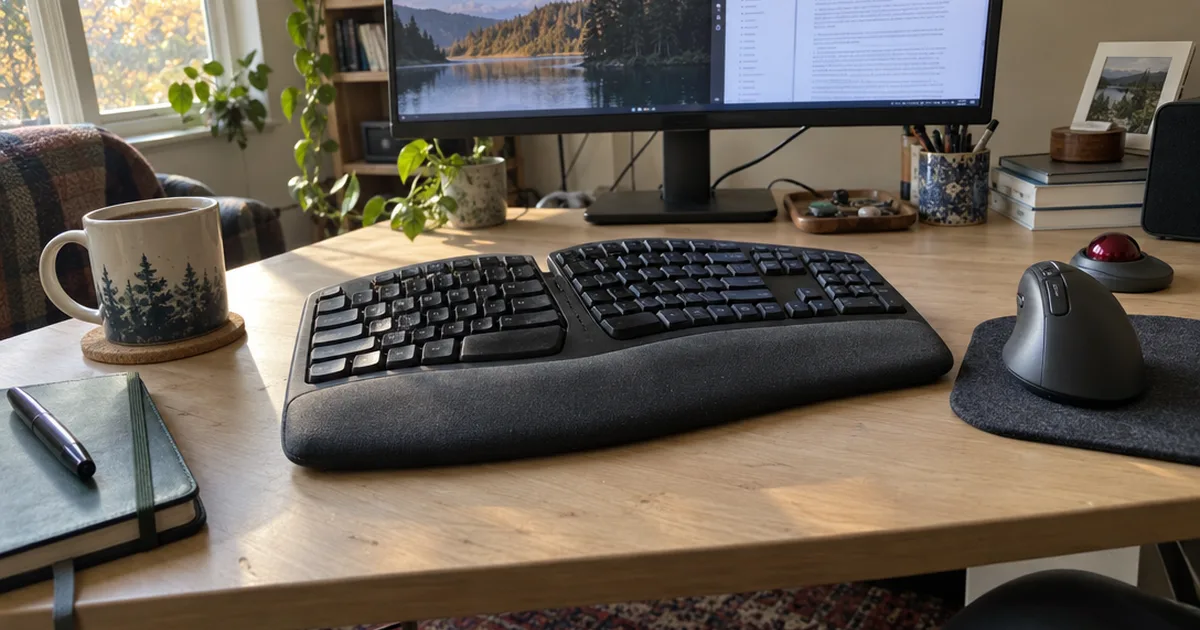
Tilting a trackball just 20 degrees cuts muscle strain by 27%, according to the Logitech MX Ergo S listing on Amazon.
That’s the idea behind ergonomic input devices: small angle changes that keep your hands, wrists and forearms out of awkward positions.
Here are 7 keyboards, vertical mice and trackballs, each matched to the strain it fixes.
- Your wrist aches after a day of mousing: #1 or #6.
- Typing hurts more than clicking: #2, or #4 if you’d rather plug in.
- Gripping or sliding a mouse is the hard part: the trackballs at #3 and #7.
Quick Comparison Chart
| # | Product | Our Rating | ||
|---|---|---|---|---|
| 1 |  |
Logitech MX Vertical Wireless Mouse | ★★★★★ | Check Price |
| 2 |  |
Logitech ERGO K860 Wireless Split Keyboard | ★★★★★ | Check Price |
| 3 |  |
Logitech MX Ergo S Wireless Trackball | ★★★★☆ | Check Price |
| 4 |  |
Microsoft Ergonomic Keyboard (LXM-00004) | ★★★★☆ | Check Price |
| 5 |  |
Goldtouch Semi-Vertical Mouse Wireless | ★★★★☆ | Check Price |
| 6 |  |
Evoluent VerticalMouse 4 Wireless | ★★★★☆ | Check Price |
| 7 |  |
Kensington Orbit Wireless Mobile Trackball | ★★★★☆ | Check Price |
The 7 Best Ergonomic Input Devices
We judged each pick on 4 things:
- The posture problem it fixes
- How hard the switch from a standard device is
- Whether its maker publishes the claim behind it
Specs come from each Amazon listing or a named source, not our own lab tests.
1. Logitech MX Vertical Wireless Mouse
Logitech MX Vertical Wireless Mouse
A rechargeable vertical mouse with a 57-degree handshake angle.
Pros
- Handshake grip ends palm-down twisting
- One-press DPI speed switch
- Textured rubber grip
Cons
- Still slides across the desk
- Upright grip takes getting used to
The Logitech MX Vertical is the best ergonomic mouse for most people, because its 57-degree handshake angle stops the palm-down forearm twist of a flat mouse.
The USDA TARGET Center lists it, repeating the maker’s claim of 10 percent less muscle activity than a standard mouse. Pick #5 instead if you want a palm flange or a left-hand model.
2. Logitech ERGO K860 Wireless Split Keyboard
Logitech ERGO K860 Wireless Split Keyboard
A curved split keyboard with a memory foam wrist rest.
Pros
- Split layout straightens your wrists
- Pillowed rest lifts your palms
- Bluetooth or USB receiver
Cons
- Split keys take practice
- Full size eats desk width
The Logitech ERGO K860 is the best ergonomic keyboard for all-day typing, since its curved, split keyframe keeps your wrists from bending outward.
Its memory foam rest gives 25% less wrist bending than a standard keyboard without a palm rest, per the K860 listing on Amazon. Pick it over #4 for wireless and tilt legs, or browse more ergonomic keyboards.
3. Logitech MX Ergo S Wireless Trackball
Logitech MX Ergo S Wireless Trackball
A thumb trackball with a 20-degree tilt and USB-C charging.
Pros
- Stays put, so your arm barely moves
- Tilt relaxes your forearm
- 80% quieter clicks (maker claim)
Cons
- Sized for medium to large hands
- Thumb does all the steering
The Logitech MX Ergo S is the trackball to get if moving a mouse is what hurts, because the device stays still while your thumb steers.
Trackballs need no significant wrist movement or grip, according to the assistive technology guide from the University of Colorado Denver. Unlike #7, it adds a 20-degree tilt; see our trackball mouse roundup for more.
4. Microsoft Ergonomic Keyboard (LXM-00004)
Microsoft Ergonomic Keyboard (LXM-00004)
A wired ergonomic keyboard with a cushioned palm rest.
Pros
- No batteries or pairing
- Palm rest supports a neutral wrist
- Ergonomist-approved design
Cons
- Some shortcut keys are Windows-only
- Cable limits placement
The Microsoft Ergonomic Keyboard is the wired pick if you want a cushioned palm rest, a full number pad and nothing to charge.
Its Natural Keyboard, introduced in 1995, was already split, says PC Tech Guide.
Not sure a new keyboard will help? See if ergonomic keyboards are worth it.
5. Goldtouch Semi-Vertical Mouse Wireless
Goldtouch Semi-Vertical Mouse Wireless
A wireless semi-vertical mouse with a detachable palm flange.
Pros
- Middle ground between flat and upright
- Flange keeps your palm off the desk
- Left-hand version sold separately
Cons
- Needs its USB dongle
- Medium size only
The Goldtouch Semi-Vertical Mouse Wireless is the sloped mouse to pick for extra palm support, thanks to its 66-degree slope and detachable flange.
USDA lists it too, noting the flange adds hand and wrist support. Goldtouch also sells a left-hand version.
6. Evoluent VerticalMouse 4 Wireless
Evoluent VerticalMouse 4 Wireless
A right-handed vertical mouse that holds your hand upright.
Pros
- Shape stops forearm twisting
- Side buttons change pointer speed
- Buttons set per program
Cons
- Right hand only
- Programming needs Evoluent software
The Evoluent VerticalMouse 4 holds your right hand upright, in a patented shape that, per its Amazon listing, stops forearm twisting.
A broad lip keeps your pinky off the desk, and side buttons change pointer speed without letting go.
7. Kensington Orbit Wireless Mobile Trackball
Kensington Orbit Wireless Mobile Trackball
A compact ambidextrous trackball with touch scrolling.
Pros
- Works in either hand
- Plug-and-play, no drivers
- Packs easily with a laptop
Cons
- No tilt for your hand
- Relies on a nano receiver
The Kensington Orbit Wireless Mobile Trackball is the pick for left-handed users or hand-switchers, because its symmetrical body works in either hand.
It’s compact, needs no drivers and scrolls by touch, and our ergonomic mice hub has other shapes.
How to Choose the Right Ergonomic Input Device
The right ergonomic input device depends on which motion hurts: a vertical mouse for forearm twisting, a trackball when gripping or moving a mouse hurts, and a split keyboard when your wrists bend outward as you type.
Here’s how that maps to the picks:
- Forearm twisting: a flat mouse turns your palm down, called pronation. The vertical mice at #1, #5 and #6 turn your hand on its side.
- Sideways wrist bend: a straight keyboard pulls your wrists into ulnar deviation. The split K860 at #2 angles each half to match your arms.
- Grip or arm movement: the trackballs at #3 and #7 stay put while your thumb or fingers steer.
Dealing with numbness from carpal tunnel syndrome? A new device changes your posture, but it isn’t a treatment, and the CU Denver guide says choosing one often takes input from an occupational or physical therapist.
Then compare our mice for carpal tunnel or mice for large hands.
Mouse Alternatives for Limited Hand Use
Mouse alternatives for limited hand use come in 6 main types beyond ergonomic mice: trackballs, touchpads, joysticks, foot mice, head pointers and eye gaze, the CU Denver guide says.
Touchpads need no grasping or wrist bending, so see our ergonomic touchpad picks. Joysticks can even be steered with your foot, chin or tongue, and our ergonomic mouse alternatives list covers more.
Frequently Asked Questions
What are ergonomic input devices?
Ergonomic input devices are keyboards, mice, trackballs and touchpads shaped to keep your hands, wrists and forearms in a neutral position. Split keyboards, vertical mice and trackballs are the most common types.
Is a vertical mouse better than a trackball?
A vertical mouse is better for forearm twisting, while a trackball is better when gripping or moving a mouse hurts, since it stays still.
Is a vertical mouse good for carpal tunnel?
A vertical mouse can make mousing more comfortable with carpal tunnel syndrome by holding your wrist in a handshake position, but it isn’t a treatment. Ask an occupational or physical therapist which device fits your symptoms.
Are there ergonomic mice for left-handed people?
Yes, left-handed users can pick the ambidextrous Kensington Orbit Wireless Mobile Trackball or the left-hand version of the Goldtouch Semi-Vertical Mouse Wireless.
Final Thoughts
Match the device to the motion that hurts: the MX Vertical at #1 for mousing, the ERGO K860 at #2 for typing.
This week, notice whether your wrist twists, bends sideways or strains to grip, then pick the matching device.